Medical herbalism. Your questions answered.
About herbal medicine
-
Herbal medicine and homeopathy are separate therapeutic systems. Clinical herbal medicine uses measurable plant compounds with known pharmacological actions in the body. These active constituents can interact with human physiology and with prescription medications, which is why herbal prescriptions are carefully formulated and reviewed for safety.
-
The three differ in training and in what they prescribe. Medical herbalists train to degree level in clinical sciences and prescribe individually formulated plant medicines. Nutritional therapists work primarily through diet and supplementation. Naturopathy is a broader philosophy that may include several approaches and whose training varies considerably between practitioners.
-
Many medicinal plants have been studied for their active compounds and their effects on human physiology. Clinical herbal medicine combines traditional knowledge practised for centuries, with modern research in pharmacology and phytochemistry.
See Events and Insights
Safety and medical care
-
Herbal medicine can be safely used alongside prescribed medication under a supervision of a trained Medical Herbalist. All herbal formulations from Helenium Clinic are carefully reviewed for potential herb–drug interactions.
-
No. Herbal medicine can be safely used alongside prescribed medication e.g. to manage occurance of side effects from the latter.
At Helenium Clinic, we have deep knowledge of herb–drug interactions, and safety is our prime concern. -
Yes, please do. Herbal medicines contain pharmacologically active compounds and your GP should have a complete picture of everything you're taking. I'm happy to correspond with your GP directly where that would be useful.
-
Yes. Where appropriate, we work collaboratively with your GP or other healthcare practitioners.
-
Some herbs are contraindicated in pregnancy and breastfeeding, and safety data varies considerably between plants. Any prescription during these periods is formulated with particular caution and some options are excluded entirely. Always tell me if you are pregnant, trying to conceive, or breastfeeding, and let me know as soon as circumstances change.
Practicalities
-
We discuss what brings you here, the nature and duration of your symptoms. We walk through how herbal medicine can support and decide whether this modality is for you.
-
We go over a detailed history of your health and symptomps to join the dots and understand the root cause of the imbalance your body is experiencing.
We then meet for regular check-ins afterwards.
The initial consultation lasts 1.5 - 2 hours. This gives time to work through your full health history, current symptoms, medications and supplements, diet, sleep and stress patterns, and to carry out any relevant clinical assessment. Follow-up appointments are shorter, usually 45-60 minutes, and take place every four to six weeks initially. -
Yes, however a preference is to see people face to face for the fist, longer visit.
-
This depends on how long-standing and complex your symptoms are. Most people begin with a three-month period of regular support. Some concerns settle within that window; others need longer. We'll review progress at each appointment and you're free to stop at any point.
-
Care at Helenium Clinic is structured as an initial programme of 3-5 months rather than one-off appointments, because persistent symptoms rarely resolve in a single visit. The programme costs £438 and includes an initial consultation of up to 2 hours, 2 follow-up appointments of one hour each, check-in texts, and all herbal formulations for the period - there are no separate dispensary charges.
Payment can be spread across 3 instalments during the course of the programme.
Before committing, you're welcome to book a free 20-minute discovery call to discuss whether this approach suits you; there's no obligation to proceed.
A concessionary rate is available for pensioners, students and those on a low income. Please mention this on our discovery call.
Treatment
-
Herbal prescriptions are developed following a detailed consultation where a medical herbalist selects specific herbs based on their known pharmacological actions, safety profile, and relevance to your individual physiology.
Prescriptions are tailored to each patient and adjusted over time as your health improves.
-
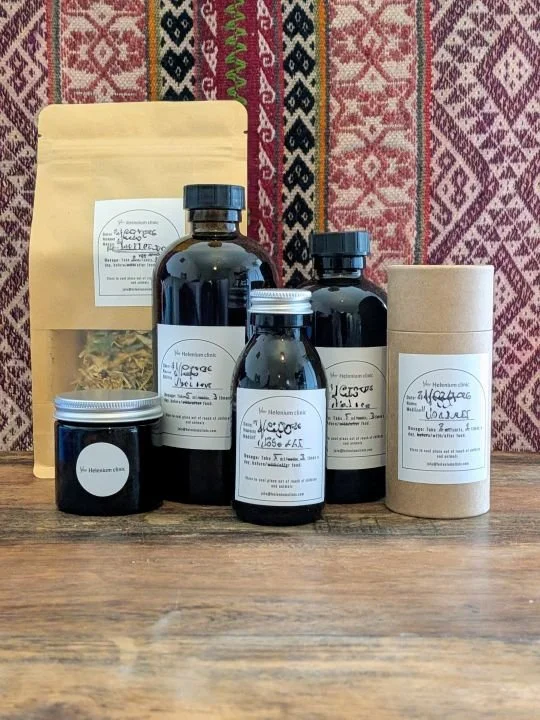
Herbal medicine can be provided in the form of liquid tinctures, capsules, herbal infusions (teas), topical creams or balms, and pessaries.
The format is selected based on what is most appropriate, effective, and practical. -
The timeline varies depending on the nature and duration of your symptoms. Some people notice improvements within a few weeks, while more complex or long-standing conditions may require longer support. Treatment is usually structured around three-month health goals, with regular reviews to monitor progress and adjust formulations where needed.em description

Suitability
-
No. Many people seek support for symptoms that are ongoing or unclear, even without a formal diagnosis. Where appropriate, collaboration with your GP or other healthcare practitioners may be recommended.
-
Often, yes. Multi-system presentations can appear together and can be difficult to address when each is looked at separately. Much of my practice involves working through a full history to find patterns that link them.
-
Herbal medicine can support a wide range of health concerns by addressing underlying imbalances in the body. Common areas of support include digestive problems, hormonal health, fatigue, inflammatory conditions, recurrent infections, skin conditions, and sleep difficulties.
We list some conditons we treat here.